Mostrando entradas con la etiqueta Apis. Mostrar todas las entradas

jueves, 11 de marzo de 2021

 INICIO DEL DIPLOMADO EN APICULTURA TROPICAL EN LINEA-

BIENVENIDOS LOS DOCE ESTUDIANTES DE TODO EL PAIS  Y MUCHO ÉXITO!!!


jueves, 10 de diciembre de 2020

 Premio Nacional de Entomología 2020 a Tesis Doctoral de Rubén Medina Hernández, egresado del Doctorado del Posgrado Institucional UADY en que participa el Departamento de Apicultura Tropical


jueves, 12 de noviembre de 2020

Guzman-Novoa E, Morfin N, De la Mora A, Macías-Macías JO, Tapia-González JM, Contreras-Escareño F, Medina-Flores CA, Correa-Benítez A and Quezada-Euán JJG (2020) The Process and Outcome of the Africanization of Honey Bees in Mexico: Lessons and Future Directions. Front. Ecol. Evol. 8:608091.                doi: 10.3389/fevo.2020.608091 

LIGA AL PDF

Abstract

 The Africanization of honey bees (Apis mellifera L.) in the Americas is among the most extensive insect invasions in the world, with large-scale effects on the economy and ecology of a whole continent. Africanized honey bees (AHBs) are a distinctive lineage of A. mellifera, resulting of the extensive admixture between African subspecies (A. m. scutellata and A.m. adansonii) with resident European stocks of honey bees introduced into the Americas. Despite its great importance, to date, the outcome of Africanization of honey bees has not been evaluated in detail. In this article we use the case of Mexico, one of the top beekeeping countries in the world, to assess the effects of Africanization of honey bees and its outcome. There is evidence of African genes in honey bee populations across Mexico, with prevalence in the tropical areas and less
so in temperate ones. The Africanization of honey bees resulted in lower honey yields per hive in temperate climates of Mexico, but this has not been assessed in the tropical regions. Mexico’s total honey production and exports at the start of the Africanization process decreased, but today, they have partially rebounded and have remained stable. As in all countries where Africanization has occurred, the defensive behavior of honey bees in Mexico increased but notably, stinging incidents involving humans have been relatively insignificant (0.23 fatalities per million people). Ecologically, AHBs seem to have posed limited impact on the native apifauna and have contributed to pollination of major economic crops, but more studies are needed to evaluate the overall effect. AHBs can be potentially more resistant to parasites and diseases and worth of note is that AHBs in Mexico resulted in a new generation of beekeepers that propelled management and selective breeding. In general, the evidence suggests that the Africanization of honey
bees in Mexico has had a less severe impact than originally predicted. We suggest some lines for future directions that may help to better understand the effects, make sustainable use and ameliorate the negative characteristics of AHBs.


miércoles, 11 de marzo de 2020

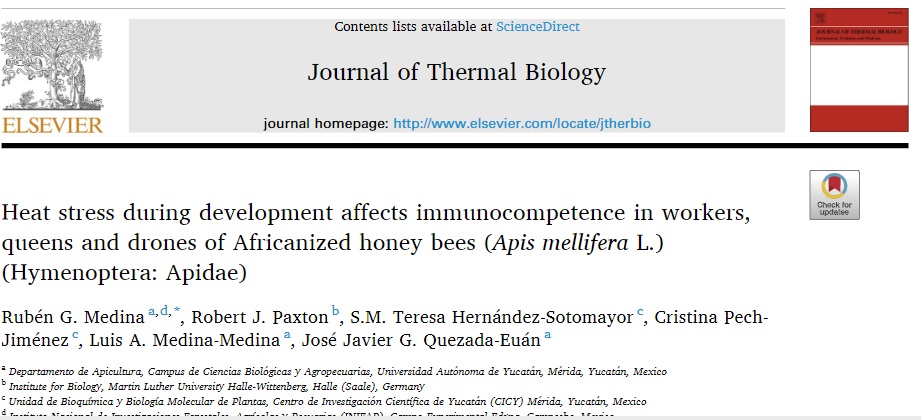
Medina R.G., Paxton R.J., Hernández-Sotomayor S.M.T., Pech-Jimenez C., Medina-Medina L.A., Quezada-Euán J.J.G. (2020) Heat stress during development affects immunocompetence in workers, queens and drones of Africanized honey bees (Apis mellifera L.) (Hymenoptera: Apidae). Journal of Thermal Biology 89: 102541 https://doi.org/10.1016/j.jtherbio.2020.102541

Abstract

Though social insects generally seem to have a reduced individual immunoresponse compared to solitary species, the impact of heat stress on that response has not been studied. In the honey bee, the effect of heat stress on reproductives (queens and males/drones) may also vary compared to workers, but this is currently unknown. Here, we quantified the activity of an enzyme linked to the immune response in insects and known to be affected by heat stress in solitary species: phenoloxidase (PO), in workers, queens and drones of Africanized honey bees (AHBs) experimentally subjected to elevated temperatures during the pupal stage. Additionally, we evaluated this marker in individuals experimentally infected with the entomopathogenic fungus Metarhizium anisopliae. Differences in PO activity were found between sexes and castes, with PO activity generally higher in workers and lower in reproductives. Such differences are associated with the likelihood of exposure to infection and the role of different individuals in the colony. Contrary to our expectation, heat stress did not cause an increase in PO activity equally in all classes of individual. Heat stress during the pupal stage significantly decreased the PO activity of AHB queens, but not that of workers or drones, which more frequently engage in extranidal activity. Experimental infection with Metarhizium anisopliae reduced PO activity in queens and workers, but increased it in drones. Notably, heat stressed workers lived significantly shorter after infection despite exhibiting greater PO activity than queens or drones. We suggest that this discrepancy may be related to trade-offs among immune response cascades in honey bees such as between heat shock proteins and defensin peptides used in microbial defence. Our results provide evidence for complex relationships among humoral immune responses in AHBs and suggest that heat stress could result in a reduced life expectancy of individuals.

 LIGA AL PDF COMPLETO EN J THERMAL BIOLOGY

jueves, 20 de febrero de 2020

Poot-Baez V., Medina-Hernández R., Medina-Peralta S., Quezada-Euán J.J.G. (2020)Intranidal temperature and body size of Africanized honey bees under heatwaves (Hymenoptera: Apidae). Apidologie  51:382–390. https://doi.org/10.1007/s13592-019-00725-5


Abstract
It is generally accepted that temperate subspecies of honey bees can maintain stable temperatures inside their nests; however, little information is available on the cooling ability of tropical honey bees and the effect of high environmental temperatures on individuals. In this study, we registered temperatures in the brood area of strong- and medium-populated colonies of Africanized honey bees during heatwaves (maximum environmental temperature 44 °C) between April and May in the tropical Yucatán Peninsula of México. To evaluate the effect on colonies, we compared the body size of workers produced under high temperatures in the field and siblings produced at stable 34–35 °C laboratory conditions. We found that in the field, temperatures of the brood nest in both types of colony can increase above 36 °C during the hottest part of the day, especially in less strong colonies. Workers produced in the field were significantly smaller, compared to those reared in the lab at stable temperatures. This is a first study reporting body size reduction in honey bees as a consequence of possible thermoregulation disruption during heatwaves. We discuss our results considering potential effects of heat stress to Africanized honey bee colonies and tropical beekeeping.

miércoles, 18 de diciembre de 2019


May-Itzá W. de J., Medina LM. (2019).  Effectiveness of the smoke of fruits of Guazuma ulmifolia (Sterculiaceae) and vapors of Thymol for control of Varroa destructor infesting Africanized bees. Rev Mex Cienc Pecu.  10(3):778-788.


 Abstract:
The mite Varroa destructor is a scourge in honey bee colonies worldwide. Conventional chemical-based control treatments can contaminate colony products and cause resistance in the parasite. Plant-source compounds are promising alternatives. The effectiveness of smoke from dried Guazuma ulmifolia fruit and vapors from thymol crystals was evaluated in control of V. destructor in colonies of Africanized bees (Apis mellifera) in Yucatan, Mexico. Three treatments were used during a three-week experimental period. In Group 1, colonies were administered five to eight puffs of smoke from dried G. ulmifolia fruits twice a week. In Group 2, they were administered 4-8 g of thymol crystals once a week. Group 3 was a control and received no treatment. Collections of 200 to 300 adult bees from each colony were done prior to treatment (day 0) and after treatment at 7, 14 and 21 d. These were processed to quantify colony infestation levels and treatment efficacy. Overall V. destructor infestation levels in adult bees decreased in all three groups after 21 d, with differences between treatments. Levels were lowest in Group 2, followed by Group 1 and the control. Efficacy at the end of the treatments was 41 % in Group 1 and 69% in Group 2. Compared to the control, application of thymol crystals provided the most effective alternative control method against V. destructor. However, regular application of G. ulmifolia fruit smoke also reduced mite infestation levels, and this resource has the advantage of being locally available.

lunes, 15 de abril de 2019

Tesista de Doctorado: Rubén Guillermo Medina Hernández. 

Título de tesis: “Efecto del estrés térmico sobre la aptitud biológica de Apis mellifera L. africanizada (Hymenoptera:Apidae)”,.

Fecha de examen profesional: 11 de abril de 2019

Asesor: Dr. José Javier G. Quezada Euán, Dr Robert J Paxton, Dr Luis A. Medina Medina


Comité Evaluador: Dr. Victor Parra Tabla, Dra Virgina Melendez R, Dr José Carlos Cervera

lunes, 10 de diciembre de 2018

Fleites-Ayil F.A., Quezada-Euán J.J.G., Medina-Medina L.A. (2018) Onset of foraging and lifespan of Africanized honey bees (Apis mellifera ) infected with different levels of Nosema ceranae spores in Neotropical Mexico. Apidologie 49:781–788. 

 Abstract Nosema ceranae is a microsporidium pathogen widely spread around the world. Negative effects on foraging behavior and longevity of European honey bee (EHB) colonies have been associated with this pathogen as well as possible population losses, but its effects have not been studied in tropical adapted honey bees. We studied the interaction between this pathogen and Africanized honey bees (AHB) in the Yucatan peninsula of Mexico where N. ceranae has only been detected since 2008. Non-infected and artificially infected workers with two different spore concentrations were introduced in observation hives to evaluate the onset and duration of foraging and longevity.
The results showed precocious foraging, a reduction of the duration of foraging and a decrease in the longevity of infected bees compared with non-infected ones. However, the results indicate that although negative effects can be caused by N. ceranae in AHB, these were of a moderate magnitude compared with similar reports on EHB in temperate areas. Further research is necessary to  evaluate the long-term effect of N. ceranae on AHBs in relation to colony dynamics to better understand the absence of significant colony losses associated with this pathogen in tropical and subtropical Mexico.

Link Apidologie

miércoles, 19 de septiembre de 2018

viernes, 6 de julio de 2018


Publicaciones Luis Medina Medina

Memorias VI Congreso Mesoamericano sobre Abejas Nativas
Actividad Antimicrobiana y Origen Botánico en Mieles de Melipona beecheii,
Scaptotrigona pectoralis
y Apis mellifera del Estado de Yucatán
Catzín Ventura Gloria A., Alfaro Bates Rita, Medina Medina Luis A., Delgado Herrera María A.
Resumen
Se analizaron palinológicamente mieles producidas por tres especies de abejas
(A. mellifera, M. beecheii y S. pectoralis) que exhibieron actividad inhibitoria (AA)sobre cuatro bacterias patógenas (Staphylococcus aureus, Streptococcus agalactiae, Escherichia coli y Pseudomona aeruginosa). Las mieles fueron colectadas en el estado de Yucatán (México), durante los meses de Octubre del 2007 a Marzo del 2008. En general, las mieles de las abejas nativas mostraron mayor AA. La bacteria que resultó inhibida por la miel de las 3 especies de abejas fue S. aureus, mientras que E. coli fue la que mostró mayor resistencia. Las mieles de A. mellifera y M. beecheii clasificadas como uniflorales, presentaron AA contra un mayor número de bacterias, mientras que las mieles de S. pectoralis mostraron AA tanto en las mieles uniflorales como multiflorales. Se identificaron un total de 16 tipos polínicos pertenecientes a 9 familias, en la miel colectada durante este período para las tres especies de abejas. Los resultados indican que las mieles provenientes de las dos especies de abejas nativas presentaron una mayor AA, en comparación con la registrada para A. mellifera. La variabilidad intra-especifica de la actividad antimicrobiana de las mieles estudiadas puede ser debido a su origen floral.
Palabras clave: Actividad antimicrobiana, abejas nativas, miel, origen botánico,
Yucatán.

Medina, M.L.; Martin, S.J. (1999) A comparative study of Varroa jacobsoni reproduction in worker cells of honey bees (Apis mellifera) in England and Africanized bees in Yucatan, Mexico. Experimental and Applied Acarology 23: 659-667.
https://link.springer.com/article/10.1023/A:1006275525463
Abstract
The aim of this study was to investigate an underlying mechanism of the apparent tolerance of Africanized honey bees (AHB) to Varroa jacobsoni mites in Mexico. This was achieved by conducting the first detailed study into the mites’ reproductive biology in AHB worker cells. The data was then compared directly with a similar study previously carried out on European honey bees (EHB) in the UK. A total of 1071 singly infested AHB worker cells were analyzed and compared with the data from 908 singly infested EHB worker cells. There was no significant difference between the number of mother mites dying in the cells (AHB=2.0%, EH=1.8%); the mean number of eggs laid per mite (AHB= 4.86, EHB= 4.93); the number of mites producing no offspring (AHB= 12%, EHB= 9%); and developmental times of the offspring in worker cells of AHB and EHB. However, there was a major difference between the percentage of mother mites producing viable adult female offspring (AHB= 40%, EHB= 75%). This was caused by the increased rate of mite offspring mortality suffered by the first (male) and second (female) offspring in AHB worker cells. Therefore, only an average of 0.7 viable adult female offspring are produced per mite in AHB, compared to 1.0 in EHB.


Medina, M.L.; Martin, S.J.; Espinosa-Montaño, L; Ratnieks, F.L.W. (2002) Reproduction of Varroa destructor in worker brood of Africanised honey bees (Apis mellifera). Experimental and Applied Acarology 27: 79-88.
https://link.springer.com/article/10.1023/A:1021579113907
Abstract
Reproduction and population growth of Varroa destructor was studied in ten naturally infested, Africanized honeybee (AHB) (Apis mellifera) colonies in Yucatan, Mexico. Between February 1997 and January 1998 monthly records of the amount of pollen, honey, sealed worker and drone brood were recorded. In addition, mite infestation levels of adult bees and worker brood and the fecundity of the mites reproducing in worker cells were determined. The mean number of sealed worker brood cells (10,070 ± 1,790) remained fairly constant over the experimental period in each colony. However, the presence and amount of sealed drone brood was very variable. One colony had drone brood for 10 months and another for only 1 month. Both the mean infestation level of worker brood (18.1 ± 8.4%) and adult bees (3.5 ± 1.3%) remained fairly constant over the study period and did not increase rapidly as is normally observed in European honey bees. In fact, the estimated mean number of mites fell from 3,500 in February 1997 to 2,380 in January 1998. In May 2000 the mean mite population in the study colonies was still only 1,821 mites. The fertility level of mites in this study was much higher (83–96%) than in AHB in Brazil(25–57%), and similar to that found in EHB (76–94%). Mite fertility remained high throughout the entire study and was not influenced by the amount of pollen, honey or worker brood in the colonies.


Correa-Marques, M.H.; Medina, M.L.; Martin, S.J.; De Jong, D. (2003) Comparing data on the reproduction of Varroa. Genetics and Molecular Research 2: 1-6.
http://www.funpecrp.com.br/gmr/year2003/vol1-2/gmr0032_abstract.htm
Abstract
Varroa destructor reproductive success is considered an important character for determining the resistance of honey bees to this mite parasite. However, most of the published data are not comparable due to the different methods of ascertaining and reporting reproduction. A recently published technique that involves reconstructing mite families in older worker brood gives repeatable and reliable parameters. This methodology was used to compare various categories of reproduction of approximately 1,000 V. destructor females in each of three studies on Africanized bees in Brazil and Mexico and European bees in England. The most objective and useful measure was the determination of the number of viable females per female that had invaded the worker brood in singly infested cells, which was denominated the “effective reproduction rate”. Viable females are those that can reach the adult stage and have a mate available. The effective reproduction rate in worker brood was 0.64, 0.73 and 1.01 in Brazil, Mexico and England, respectively. Standardization of reproduction determination techniques would make published data comparable and much more useful.


Martin, S.J.; Medina, L.M. (2004) Africanized honeybees possess unique tolerance to Varroa mites. Trends in Parasitology. 20(3): 112-114.
https://www.sciencedirect.com/science/article/pii/S1471492204000169?via%3Dihub
Varroa destructor is an ectoparasitic mite of the adult honeybee, which parasitizes the bee brood. This mite has killed millions of honeybee Apis mellifera colonies, worldwide, eliminating wild populations throughout Europe and North America, and resulting in the loss of billions of dollars in agricultural production. The Africanized honeybee (AHB) has a unique tolerance to V. destructor that is not present in the A. mellifera European honeybee (EHB), from which the AHB hybrid was derived. This unexpected tolerance mechanism provides a valuable insight into the evolution of host–parasite interactions….


May-Itzá, W. de J.; Medina, M.L.; Marrufo, O.J. (2007) Effectiveness of a thymol based gel for the control of Varroa destructor mite that infests Apis mellifera honey bee colonies, under tropical conditions in Yucatan, Mexico. Veterinaria México 38 (1): 1-8.
Abstract
The effectiveness of a thymol based gel (12.5 g of thymol in 50 g of gel) for controlling Varroa destructor in commercial honey bee (Apis mellifera) colonies under tropical conditions was evaluated. Three groups of honey bee colonies were used, the first group received one tray containing thymol gel (G1), the second group received two trays with thymol gel (G2) and the third group (control) received no treatment (G3).The application of the gels was repeated twice with two weeks between treatments. In total G1 received 2 trays and G2 received 4 trays of thymol gels, thus the honey bee colonies and the mites were exposed to the thymol gels during 30 days. The mite infestation levels in adult bees and capped brood were registered before and after the application of the treatments in order to evaluate the effectiveness of the thymol based gels. The effectiveness of the treatments estimated for adult bees was 97% and 93% for G1 y G2, respectively, and in the capped brood the effectiveness was 94% and 95% for both groups respectively. The results show that the application of one thymol gel (G1) tray with a second application in a 15 days interval (total of two trays) can eliminate ≈95% of the mites in honey bee colonies under tropical conditions and thus can be used as an alternative method for the apiculturist of this region to control this parasite.


Martínez Puc, J.F.; Medina, M.L. (2011) Evaluation of the resistance of the mite Varroa destructor to the fluvalinate in colonies of honey bees (Apis mellifera) in Yucatan, Mexico. Revista Mexicana de Ciencias Pecuarias 2(1): 93-99.
http://cienciaspecuarias.inifap.gob.mx/index.php/Pecuarias/article/view/1451
Abstract
The constant application of pyrethroids for controlling the mite Varroa destructor has caused the appearance of populations of resistant mites to this product in several parts of the world. With the purpose of detecting the possible existence of populations of resistant mites to the fluvalinate in the State of Yucatan, one of the main honey producer states in Mexico, 12 samples were gathered from each apiary, selecting four apiaries where fluvalinate was used in constant way for the control of V. destructor during five years, and a similar quantity of samples coming from apiaries where methods of alternative control have been used during a similar time. To determine from the mites the percentage of mortality to the fluvalinate, they were exposed to a piece of 2.5 x 1.0 cm from Apistan® at 10%, during 24 h. The percentage of mortality of varroas coming from apiaries treated in a constant way with fluvalinate was of 83.6 ± 0.51 %, lower to the percentage of mortality obtained in apiaries that only received alternative treatment which was of 93.9 ± 1.98 %, existing differences between both groups (t=-3.93, P=0.01, gl= 46). This means a reduction in the percentage of mortality obtained with the fluvalinate. However, this reduction still does not reach the necessary levels that can define the presence of resistant mites, being important to change the practices that seem to reduce the levels of infestation of V. destructor. Then it is advisable the application of methods of alternative control which don’t cause the resistance development in the populations of mites.