miércoles, 1 de junio de 2016

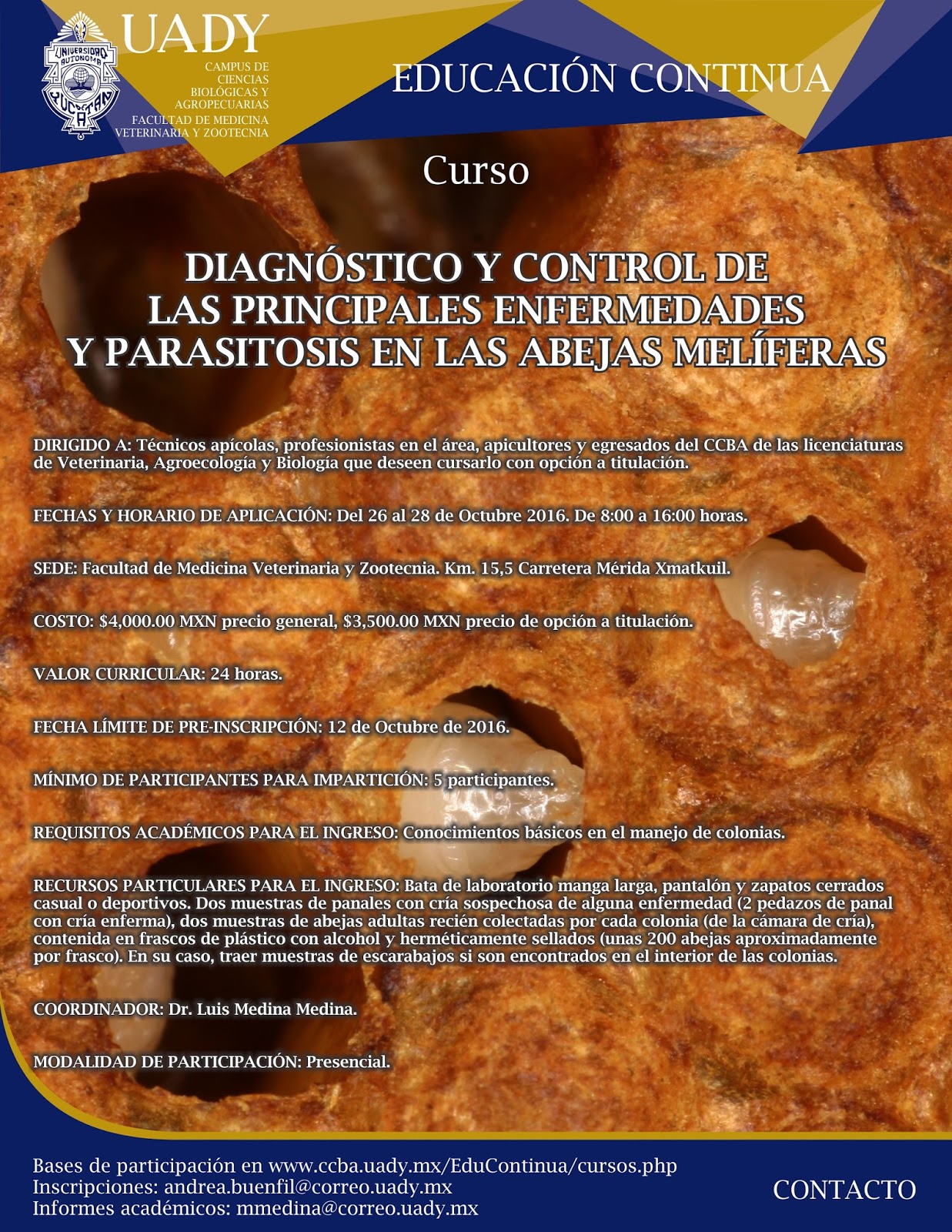
Curso de Educación Contínua: "Diagnóstico y control de las principales enfermedades y parasitosis en las abejas melíferas" 

Inicio en Octubre 2016

Instructores: Dr Luis Medina Medina y Dr William May Itzá


PROGRAMA DEL CURSO

jueves, 26 de mayo de 2016

Visitantes: Philipp Brand (Davis California) e Ismael Hinojosa (UNAM) en compañia de Rubén Medina (estudiante de Doctorado) y Javier Quezada colectando abejas euglossinas como contribución al análisis genómico de las mismas


miércoles, 4 de mayo de 2016

Macias Macias J O; Quezada-Euán J J G (2015) Stingless bees in a temperate climate: oviposition behavior and duration of ontogenic development stages in Melipona colimana (Hymenoptera: Meliponini). J. Apicultural Res. 54: 255-259

Abstract

Melipona colimana is a stingless bee endemic to temperate areas of the Trans-Mexican volcanic belt, where intranest behavior during the provisioning and oviposition process, duration of ontogenic development stages and time of emergence of individuals were determined. It was observed that the dynamics of provisioning and oviposition do not differ substantially from tropical species of the same genus, but ontogenic development in a temperate climate was longer than in a tropical climate, possibly due to lower temperatures in the original habitat of the species. Duration of ontogenic
development of M. colimana individuals is the longest recorded so far among the species of Melipona genus. Worker bees took 55.44 ± 1.09 days to emerge from the cells; males, 57.14 ± 0.94 and gynes, 52.62 ± 0.63, with statistical differences between them (F = 367.72, DF = 2, 395, p < .05). The gynes emerged before workers, and workers before the males. The obtained data can be used to promote the sustainable use of this species in mountains in Mexico.

viernes, 15 de abril de 2016


Gutiérrez E., Ruiz D., Solís T., May-Itzá W. de J., Moo-Valle H., Quezada Euán J.J.G. (2016) Does larval food affect cuticular profiles and recognition in eusocial bees? a test on Scaptotrigona gynes (Hymenoptera: Meliponini). Behav Ecol. Sociobiol. 70: 781-789


Abstract
The relative contributions of heritable and environmentally acquired components of colony odor towards individual recognition are scarcely known in social insects. Larval food may affect cuticular profiles which in turn may serve as cues in the process of elimination of excess gynes characteristic of the eusocial stingless bees. In this study we evaluated the contribution of larval food to cuticular profiles of stingless bee gynes and quantitatively tested if recognition (latency) from workers may be related to gyne chemotype and origin in the species Scaptotrigona pectoralis. Our results showed that the origin of food did not significantly affect the cuticular profiles of gynes, as larvae of the same origin reared on food from different colonies showed similar cuticular profiles at emergence. We suggest that overlapping over floral resources may account for the similarity in cuticular cues derived from food across experimental colonies. Additionally, workers showed similar latency time to first aggression towards gynes irrespectively of their chemotype and origin. Gyne’s mass had no effect on the aggressive response from workers either. We observed that gynes threatened aggressive workers which counteracted further aggression. Our results indicate that in stingless bees cuticular hydrocarbons at emergence seem to have genetic origin and that gyne tolerance seems not related to cuticular chemical profiles. We suggest that cuticular cues may serve as caste labels for the identification of newly emerged gynes after which worker aggression towards them would elicit behavioral indicators of their fitness. 

jueves, 17 de marzo de 2016

Arturo Bustillos Godoy

Tesis de Licenciatura: Diferencias en tamaño y Asimetría Fluctuante en individuos y castas de la abeja sin aguijón Melipona beecheii Benett (Hymenoptera: Apidae: Meliponini)


Fecha de examen 17 de Febrero de 2016

 Asesor: Dr J Javier Quezada Euán

PDF Insectes Sociaux 

jueves, 3 de marzo de 2016

Professor Robert J. Paxton and Alice Segurét estancia del 8 de febrero al 27 de marzo de 2016 para dar inicio al proyecto DFG

Phenotypic plasticity and reproduction-longevity life-history trade-off: investigating the underlying basis in an orchid bee at the cusp of sociality


sábado, 27 de febrero de 2016

UN Report: Pollinators Vital to Our Food Supply Under Threat

Reporte de las Naciones Unidas: Polinizadores vitales para nuestro suministro alimenticio en riesgo


By the numbers

  • 20,000 – Number of species of wild bees. There are also some species of butterflies, moths, wasps, beetles, birds, bats and other vertebrates that contribute to pollination.
  • 75% – Percentage of the world's food crops that depend at least in part on pollination.
  • US$235 billion–US$577 billion – Annual value of global crops directly affected by pollinators.
  • 300% -- Increase in volume of agricultural production dependent on animal pollination in the past 50 years.
  • Almost 90% -- Percentage of wild flowering plants that depend to some extent on animal pollination.
  • 1.6 million tonnes – Annual honey production from the western honeybee.
  • 16.5% -- Percentage of vertebrate pollinators threatened with extinction globally.
  • +40% – Percentage of invertebrate pollinator species – particularly bees and butterflies – facing extinction
VINCULO LINK A IPBES